News
India and Japan Deepen Healthcare Ties with Focus on Supply Chain, Digital Health, and Workforce Development
 Our Correspondent,
Our Correspondent,
Our Correspondent,
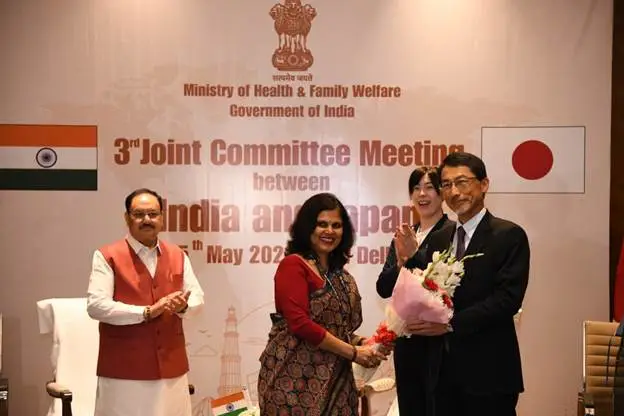
New Delhi, May 5 — India and Japan have reaffirmed their commitment to building stronger, more resilient healthcare systems through a landmark bilateral meeting held in the national capital on Tuesday. The third Joint Committee Meeting (JCM) on Healthcare brought together senior officials and ministers from both nations to map out a shared vision for the future of health cooperation, covering areas ranging from pharmaceutical supply chains and digital health infrastructure to medical workforce exchange and innovation.
The meeting was co-chaired by Union Minister of Health and Family Welfare Jagat Prakash Nadda and Japan's Minister in charge of Healthcare Policy Kimi Onoda. The discussions underscored the deepening strategic partnership between Asia's two largest democracies in the health sector and reflected a mutual recognition that robust healthcare systems are foundational to long-term national resilience.
Opening the session, Minister Nadda emphasized that the meeting was a natural extension of the shared commitment both nations have demonstrated toward healthcare cooperation. He pointed out that the India-Japan collaboration in the health domain is underpinned by a formal Memorandum of Cooperation in Healthcare and Wellness, which provides an institutional framework for advancing joint priorities. Nadda noted that the guiding philosophy of 'Sabka Saath, Sabka Vikas' — meaning inclusive development for all — continues to shape India's approach to both domestic and international health partnerships. He described the JCM as a critical platform for translating that shared vision into concrete, actionable outcomes.
For her part, Minister Onoda reaffirmed Japan's commitment to expanding its engagement with India in healthcare, particularly through innovation, cutting-edge technology, and collaborative research. She expressed a clear readiness to push bilateral cooperation into deeper territory, signaling that Japan views India not just as a partner in health diplomacy, but as a key collaborator in shaping the future of global health systems.
Welcoming the Japanese delegation separately, Union Health Secretary Punya Salila Srivastava struck a tone of warmth and optimism, describing the India-Japan partnership as one built on mutual respect, trust, and a common vision for what the future of healthcare should look like. Her remarks set a cooperative and forward-looking tone for the technical discussions that followed.
The bulk of the JCM was devoted to in-depth discussions across four major priority areas — non-communicable diseases, supply chain resilience, digital health, and human resource development — each of which carries significant implications for how both countries manage healthcare delivery in the years ahead.
Conference
Conference
Conference
Conference
Conference
Conference
Summit
On the critical issue of non-communicable diseases, India drew attention to its expanding disease burden, presenting a comprehensive response framework that prioritizes early screening, continuity of care across the health system, and public health promotion. Notably, India's approach is aligned with the United Nations Sustainable Development Goals, reflecting a commitment to global health benchmarks. Japan, meanwhile, shared details of its active cooperation initiatives in this space, including programs focused on cancer screening, early diagnosis infrastructure, and capacity-building projects designed to strengthen India's clinical capabilities.
The conversation around supply chain resilience was particularly significant given the global disruptions that have reshaped pharmaceutical and medical supply networks in recent years. India highlighted its robust pharmaceutical and medical devices manufacturing ecosystem, which has established the country as a major producer and exporter of generic medicines and health products. India also pointed to ongoing efforts to scale up domestic production capacity and ensure affordable access to essential medical products — both domestically and internationally. Japan, in turn, offered a complementary perspective, sharing its model of public-private collaboration to strengthen medical supply chains and accelerate the deployment of advanced health technologies.
Digital health emerged as another focal point of the discussions. India outlined the ambitious scope of its Ayushman Bharat Digital Mission, which is progressively building an interoperable, citizen-centric digital health ecosystem across the country. The mission aims to give every Indian citizen a digital health identity and enable seamless access to health records and services. Japan shared its own experience in health digitalisation, including the integration of artificial intelligence-enabled medical technologies into clinical and diagnostic workflows, as well as its track record in supporting collaborative health research.
On the human resource front, India showcased the depth and scale of its healthcare workforce ecosystem, highlighting existing exchange programmes that have already facilitated professional development between the two countries. Japan outlined its own ongoing investments in joint research initiatives and personnel exchange programmes, reinforcing the idea that people-to-people cooperation is as vital to healthcare partnership as policy alignment.
The third JCM on Healthcare reflects the momentum that has been building in India-Japan relations across multiple sectors, and its outcomes are expected to inform the next phase of bilateral health cooperation. With both sides committing to continued engagement and signaling appetite for even deeper collaboration, the meeting represents a significant step toward a future where India and Japan serve as mutual pillars of global health resilience.
Explore the latest edition of Journal of Supply Chain Magazine and be part of the JOSC News Bulletin.
Discover all our upcoming events and secure your tickets today.
Journal of Supply Chain is a Hansi Bakis Media brand.
Subscribe to our Daily Newsletter
Subscribe For FreeBy continuing you agree to our Privacy Policy & Terms & Conditions