News
Amazon Opens Its Logistics Network to All Businesses — And UPS, FedEx Are Already Feeling It
 Our Correspondent,
Our Correspondent,
Our Correspondent,
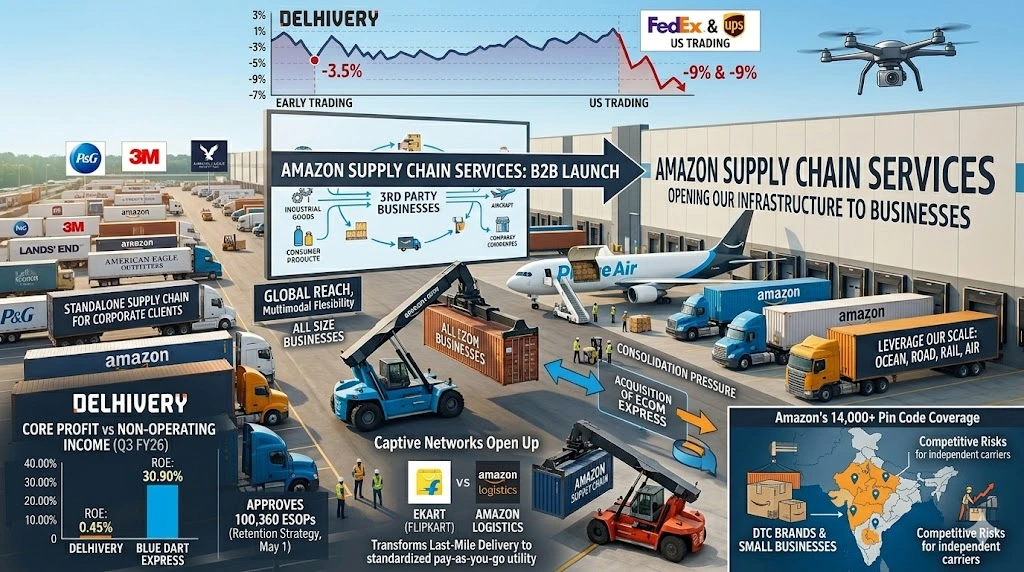
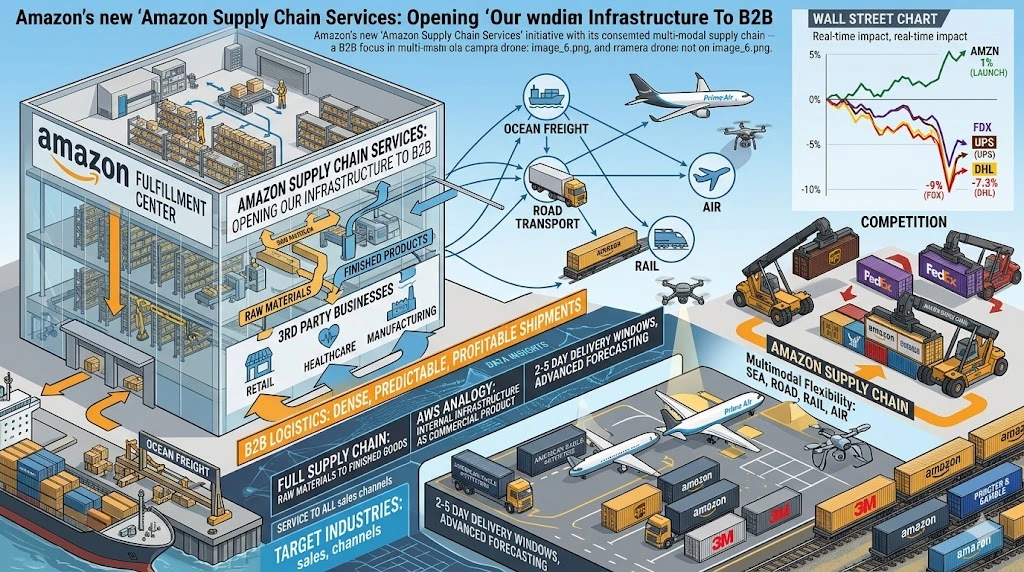
Amazon has officially entered the business-to-business logistics market in a major way. The company announced on Monday the launch of Amazon Supply Chain Services, a sweeping new offering that gives businesses of all sizes access to Amazon's vast logistics infrastructure — spanning ocean freight, road transport, rail, and air — to move goods from raw materials all the way to finished products reaching customers.
The announcement signals a dramatic expansion beyond Amazon's traditional role as a retailer and third-party seller fulfillment platform. For the first time, companies entirely outside the Amazon marketplace ecosystem can tap into the same warehousing, sorting, and delivery network that has made Amazon one of the most efficient logistics operators in the world.
The ripple effects were immediate on Wall Street. Shares of FedEx and UPS each tumbled more than 9 percent following the announcement, while Amazon's stock edged up nearly 1 percent. Contract logistics players also felt the pressure — DHL shares slid 7.3 percent, GXO Logistics fell nearly 13 percent, and Maersk held relatively steady amid the broader selloff.
Amazon currently operates a fleet of over 100 cargo aircraft, making it the third-largest air cargo operator in the United States, trailing only UPS and FedEx. Combined with its expansive web of fulfillment centers, delivery hubs, and last-mile infrastructure, the company is now positioning that entire network as a commercial product available to any business that wants faster, more predictable supply chain performance.
Businesses that sign on with Amazon Supply Chain Services will gain access to two-to-five-day delivery windows, advanced inventory forecasting tools, and distribution capabilities that work across every sales channel — from branded websites and social media storefronts to brick-and-mortar retail locations. The service is not limited to e-commerce companies. Amazon is explicitly targeting industries like retail, healthcare, and manufacturing, where supply chain efficiency has a direct impact on margins and customer satisfaction.
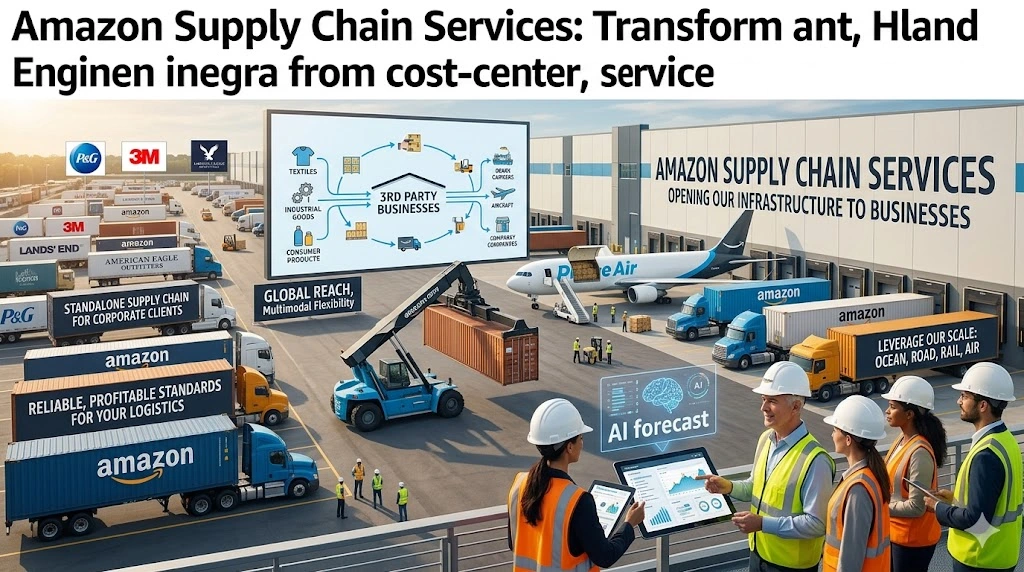
Some of the earliest adopters are household names. Procter & Gamble, 3M, and American Eagle Outfitters have already signed on to use the service, lending it immediate credibility and signaling that large enterprises see genuine value in what Amazon is offering.
Analysts at Evercore ISI described the launch as a direct competitive blow to traditional parcel carriers. The B2B shipping segment that Amazon is now aggressively pursuing is widely considered more attractive than consumer parcel delivery — shipments tend to be denser, volumes are more predictable, and margins are typically higher.
Conference
Conference
Conference
Conference
Conference
Conference
Summit
That combination makes it particularly valuable, and particularly threatening to incumbents who have long relied on those accounts for stable revenue.
"Amazon is converting logistics from a cost burden into an infrastructure product," said Parth Talsania, CEO of Equisights Research. The analogy many are reaching for is Amazon Web Services. When AWS launched in 2006, it was essentially Amazon's internal IT infrastructure being offered to the outside world. Today, it is the dominant global cloud computing platform and one of Amazon's most profitable business units. The question being asked across the logistics industry is whether Amazon Supply Chain Services is following the same trajectory.
The parallel is hard to dismiss. Just as AWS monetized excess server capacity and engineering expertise that Amazon had already built for its own operations, Supply Chain Services monetizes the warehousing, transportation, and distribution capabilities Amazon built to run its own marketplace. The infrastructure already exists. The capital has already been spent. Offering it to outside businesses is a way to generate incremental revenue from assets that are already operational.
For UPS and FedEx, the threat is compounded by timing. Both carriers have been actively pivoting toward premium verticals like healthcare logistics, data center supply chains, and high-value B2B shipments in an effort to protect margins and distance themselves from the cutthroat pricing of standard parcel delivery. Amazon's entry into that exact space narrows the runway for those strategies.
Analysts at Baird are anticipating near-term softness across several logistics subsectors, including less-than-truckload shipping, air freight, and freight forwarding, as the market reassesses competitive positioning and contract renewals in light of Amazon's move. Shippers who are currently locked into contracts with traditional carriers will likely begin weighing Amazon as an option when those agreements come up for renewal.
For businesses evaluating their supply chain strategy, the launch introduces a genuinely new option. Amazon's scale, technology stack, and data-driven approach to inventory and routing offer capabilities that smaller third-party logistics providers simply cannot match, and at pricing that could be difficult for even the largest incumbents to compete with at scale.
Whether Amazon Supply Chain Services ultimately reshapes the industry the way AWS reshaped cloud computing remains to be seen. But the opening move has clearly been made — and the companies that have built their businesses around being the infrastructure that others rely on are now facing a competitor that built that same infrastructure for itself first.
Explore the latest edition of Journal of Supply Chain Magazine and be part of the JOSC News Bulletin.
Discover all our upcoming events and secure your tickets today.
Journal of Supply Chain is a Hansi Bakis Media brand.
Subscribe to our Daily Newsletter
Subscribe For FreeBy continuing you agree to our Privacy Policy & Terms & Conditions