News
From Mumbai Spreadsheets to AI-Powered Hospital Supply Chains: The Reuben Philip Story
 Our Correspondent,
Our Correspondent,
Our Correspondent,
Reuben Mathew Philip carries an unusual distinction in American healthcare. The AI-powered products he has helped build at Clarium Health, a New York-based technology company, are now used daily by more than ten major hospital systems that collectively treat millions of patients every year. Ochsner Health, Geisinger, Yale New Haven Health, and Texas Medical Centre are among the institutions that rely on the company's software to keep their supply chains running smoothly and efficiently.
Philip grew up in Mumbai and studied computer engineering at the Don Bosco Institute of Technology before relocating to the United States for graduate school. A career in healthcare was never part of the plan. But a job at Boston Children's Hospital after completing his Master of Science in Engineering Management at Northeastern University in Boston changed everything.
"I walked into a world where billion-dollar hospital systems were still tracking supply disruptions on spreadsheets," Philip recalled. "Nurses were leaving operating rooms to hunt for supplies. Contracts worth millions were being mispaid because nobody had automated the reconciliation process. I thought, there has to be a better way."
At Boston Children's, Philip built that better way. Working within the supply chain administration team, he wrote automation scripts that eliminated more than 53 hours of manual work per week. He created a system that reduced the hospital's billing exception rate by 20 percent. He also developed a COVID expense tracking tool that hospital leadership used to successfully claim federal reimbursements. Several of those tools remain in active use today.
After a period at Amazon working on logistics automation, Philip made a move that many would consider counterintuitive. He left one of the world's largest and most well-resourced companies to join Clarium Health as its sixth employee and first data engineer. At the time, the company had zero paying customers. Philip, however, saw a clear opportunity: take the knowledge he had gained building tools for a single hospital and scale it into a platform capable of serving the entire healthcare industry.
Clarium has since raised more than $43 million in venture funding from investors including General Catalyst, Northzone, AlleyCorp, and Kaiser Permanente Ventures. Philip was quickly elevated into a product leadership role, a move driven by his rare and deep subject matter expertise in healthcare supply chain operations, the precise domain Clarium was targeting.
The stakes involved were substantial. American hospitals spend hundreds of billions of dollars on medical supplies each year, yet the vast majority lack basic visibility into their own supply chains. The COVID-19 pandemic laid bare just how fragile those systems truly were, with hospitals across the country scrambling to secure personal protective equipment, ventilators, and essential medications under enormous pressure.
Philip has since led the creation of two products that are fundamentally changing how American hospitals manage their supply chains.
The first, called Disruption Monitor, uses artificial intelligence to aggregate data from hospitals, distributors, and medical device vendors in real time.
Conference
Conference
Conference
Conference
Conference
Conference
Summit
It detects potential supply shortages before they can affect patient care and recommends substitute items based on intelligence gathered and shared across Clarium's growing network of hospital customers. The system gives procurement and supply chain teams advance warning that previously did not exist.
The second product, Card Optimizer, addresses waste within surgical operations. It analyses data drawn from hospital electronic medical record systems to identify inconsistencies in the supply lists used for surgical procedures, then generates specific recommendations for standardization. The outcome is measurably less waste and lower costs, all without altering clinical outcomes or compromising care quality.
Under Philip's product leadership, Clarium has grown from zero customers to serving more than ten of the largest health systems in the country, with zero customer churn across that entire period of growth.
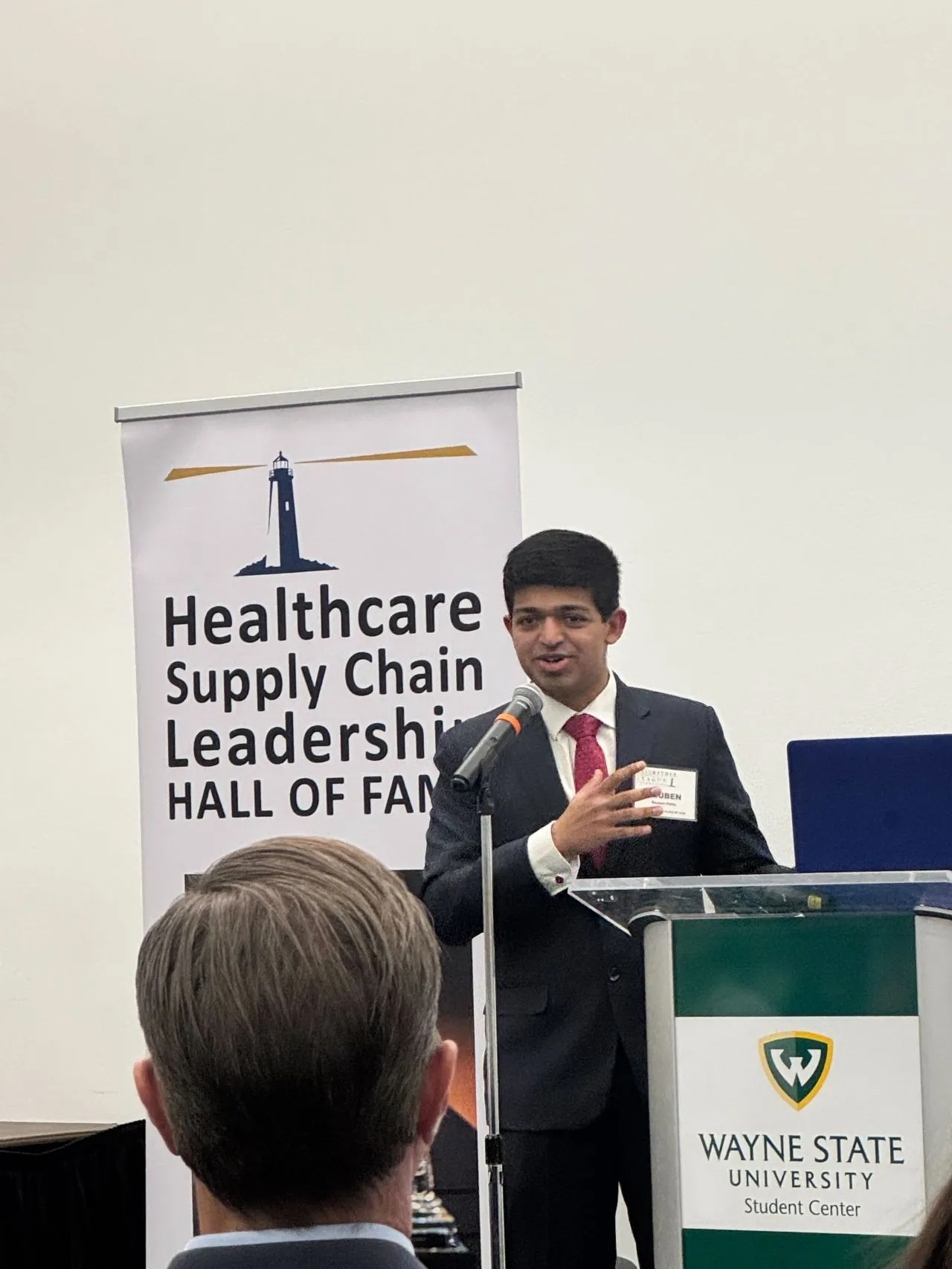
The broader healthcare industry has taken notice. In November 2025, Philip received the Future Famer Award from the Bellwether League Foundation, an American nonprofit dedicated to recognising leaders who have made lasting contributions to the healthcare supply chain field.
The Future Famer distinction is awarded to only a small number of professionals nationally each year. It recognises early-career work that signals the kind of sustained, long-term impact the organisation looks for in its Hall of Fame inductees. The 2025 class included just three recipients. The other two were a chief supply chain officer at a major Midwest health system and a system director at the University of Kansas Health System. Philip was the only technology company professional honoured, a detail that reflects how his work has resonated across the broader healthcare supply chain community, not merely within the technology sector.
Philip also holds a significant leadership position in the field's most important professional organisation. He chairs the Young Professionals Advisory Council of AHRMM, the Association for Health Care Resource and Materials Management, which operates under the umbrella of the American Hospital Association. He sits on AHRMM's Education Committee and has been selected to review abstracts submitted for the organisation's national conference by senior industry executives and established practitioners.
He is a frequent speaker at major US healthcare conferences, including AHRMM, AHVAP, HIDA, and Health Connect Partners. He has also published multiple whitepapers and articles exploring AI applications in the healthcare supply chain, contributing to the intellectual infrastructure of the field at a critical moment in its evolution.
Looking ahead, Philip says the American healthcare system is only beginning to grasp the role that intelligent technology can play in supply chain management.
"In India, we grow up understanding that resources aren't unlimited," he said. "That perspective is actually very relevant in American healthcare right now. Hospitals can't afford to waste supplies or react to disruptions after the fact. They need systems that are intelligent enough to anticipate problems. That's what we're building."
Philip continues to drive product strategy and development at Clarium Health, focused on expanding the platform's capabilities as new hospital clients come on board and as the demands of an evolving healthcare landscape grow more complex.
"Every piece of technology we build is connected to a patient outcome somewhere down the line," he said. "That's what keeps me going."
Explore the latest edition of Journal of Supply Chain Magazine and be part of the JOSC News Bulletin.
Discover all our upcoming events and secure your tickets today.
Journal of Supply Chain is a Hansi Bakis Media brand.
Subscribe to our Daily Newsletter
Subscribe For FreeBy continuing you agree to our Privacy Policy & Terms & Conditions