News
Amazon Opens Its Logistics Network to Third Parties, Putting Pressure on Delhivery and Global Carriers
 Our Correspondent,
Our Correspondent,
Our Correspondent,
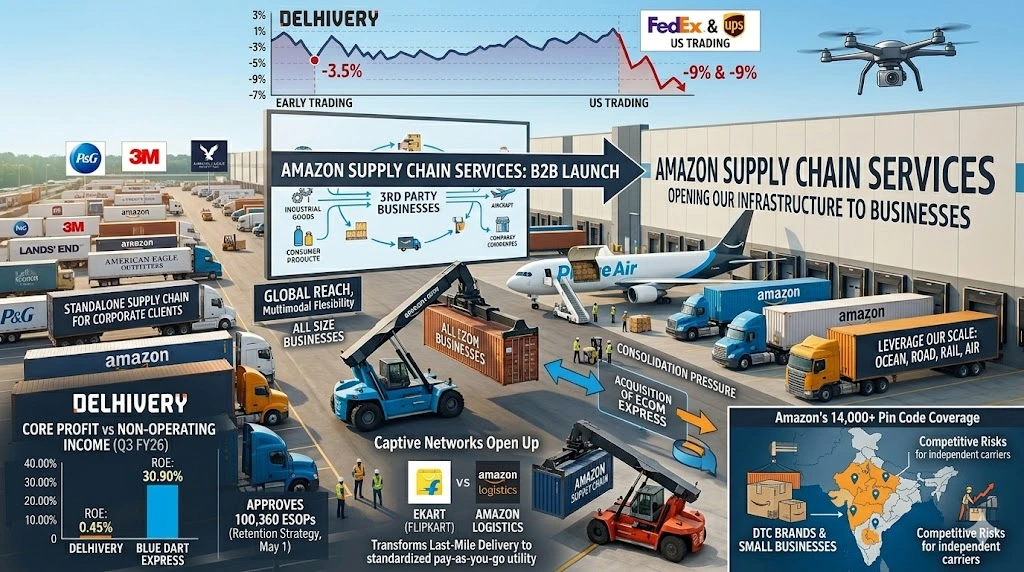
Shares of Delhivery dropped as much as 3.5% in early trading after Amazon announced a major strategic shift — opening its supply chain infrastructure to third-party businesses. The move marks a significant expansion of Amazon's logistics ambitions beyond its own e-commerce ecosystem and is already sending ripples across the global freight and delivery industry.
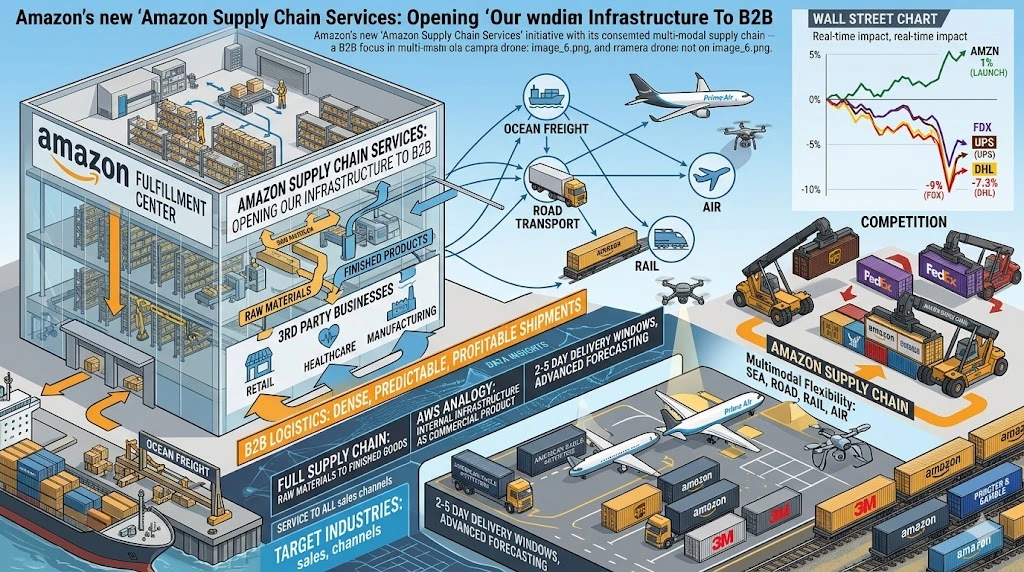
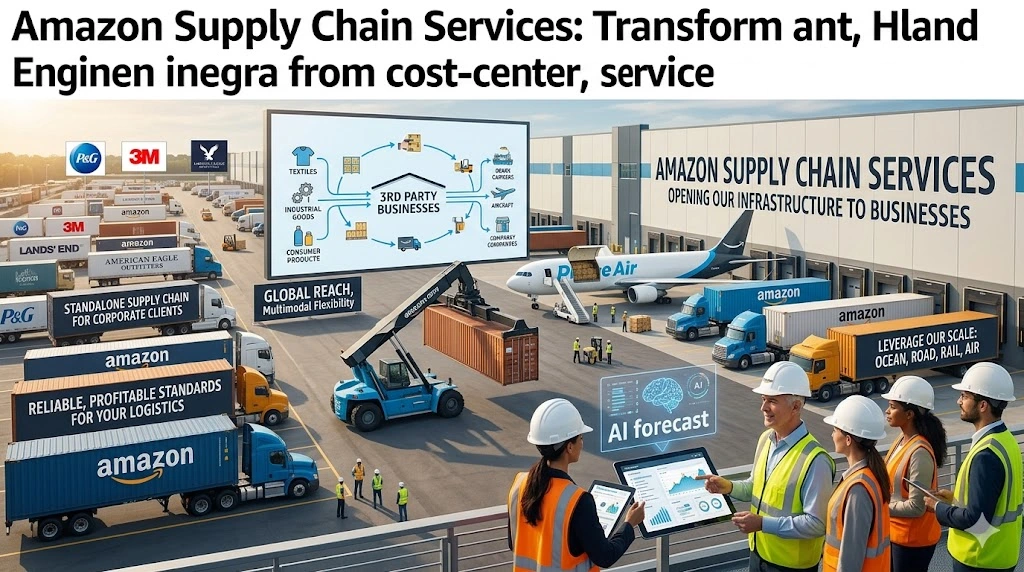
Under this new model, companies of all sizes can store and ship goods using Amazon's fully integrated network, which spans freight, warehousing, fulfillment centers, and last-mile delivery. By unlocking this infrastructure for external clients, Amazon is directly entering the business-to-business logistics space — a market that players like Delhivery, FedEx, and UPS have long dominated.
The announcement triggered a swift and sharp reaction in global markets. Shares of FedEx and UPS each fell more than 9% in US trading, reflecting investor fears that Amazon's vast scale and technology-driven efficiency could undercut traditional logistics providers on both price and service quality. For Delhivery, the sell-off comes at a particularly sensitive time, given ongoing questions about the company's profitability trajectory.
In Q3 FY26, Delhivery reported a net profit of 396 million rupees — approximately US$4.17 million — but analysts noted that the figure was largely propped up by non-operating income rather than core business performance. The company's return on equity stands at just 0.45%, a stark contrast to Blue Dart Express, which posted a return on equity of 30.90% over the same period. These numbers have kept investor confidence measured, even as Delhivery continues to scale its operations.
On the same day as the Amazon announcement, Delhivery approved 100,360 employee stock options under its ESOP 2012 scheme, effective May 1, with an exercise price of Re 1 per share.
Conference
Conference
Conference
Conference
Conference
Conference
Summit
While the move is part of routine employee retention efforts, the timing draws attention to the company's broader strategy to hold onto talent as competitive pressures intensify.
Amazon's decision is part of a wider industry pattern. Flipkart's logistics arm, Ekart, has been making similar moves — gradually opening its captive delivery infrastructure to outside businesses. As more e-commerce giants commercialize their logistics networks, the industry could see last-mile delivery evolve into a standardized, pay-as-you-go utility available to any brand willing to plug into these platforms.
For direct-to-consumer brands and small businesses, the implications are significant. Amazon's network reportedly covers more than 14,000 pin codes across India, offering logistics reach that would be prohibitively expensive to replicate independently. Access to such coverage on a variable-cost basis could level the playing field for smaller players who previously lacked the infrastructure to compete with larger retailers on delivery speed and reliability.
However, the democratization of logistics access comes with a catch. As deep-pocketed tech companies flood the contract logistics market, independent carriers may find it increasingly difficult to compete on price. This could accelerate consolidation across the sector, with smaller and mid-tier logistics firms either merging or exiting the market altogether.
Delhivery's recent acquisition of Ecom Express is widely seen as a direct response to this mounting pressure. By absorbing a competitor, the company aims to build the scale necessary to remain relevant in an environment where network size, technology investment, and operational efficiency are becoming minimum requirements rather than competitive advantages.
The broader message from Amazon's announcement is clear: logistics is no longer just a support function — it is a product. As technology companies reframe supply chain infrastructure as a service to be sold, the competitive dynamics of India's logistics sector are being fundamentally redrawn. For incumbents like Delhivery, the path forward will require not just scale, but a sharper focus on profitability and differentiation in a market that is rapidly being reshaped from the outside in.
Explore the latest edition of Journal of Supply Chain Magazine and be part of the JOSC News Bulletin.
Discover all our upcoming events and secure your tickets today.
Journal of Supply Chain is a Hansi Bakis Media brand.
Subscribe to our Daily Newsletter
Subscribe For FreeBy continuing you agree to our Privacy Policy & Terms & Conditions