News
CJ Darcl and NHEV Join Forces to Launch Heavy Electric Freight on India's E-Highways
 Our Correspondent,
Our Correspondent,
Our Correspondent,
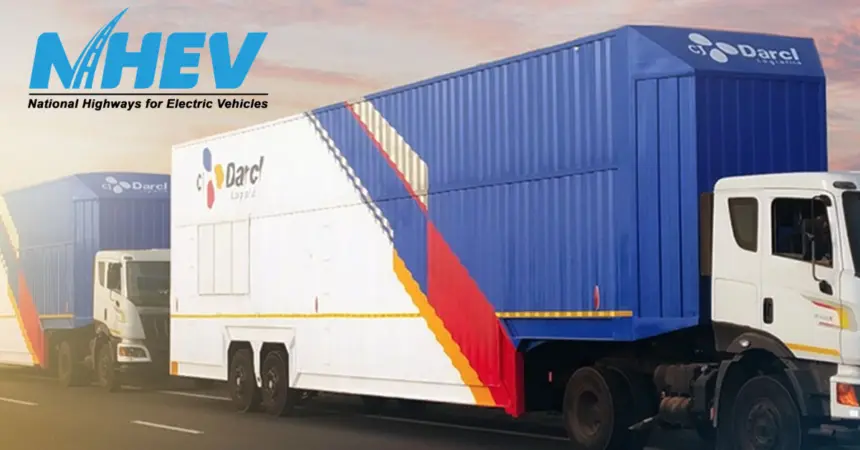
CJ Darcl Logistics has signed a Memorandum of Understanding with National Highways for Electric Vehicles under India's Ease of Doing Business programme, marking a significant step toward electrifying the country's heavy freight sector. The agreement focuses on assessing the commercial viability of deploying heavy electric vehicles on NHEV's upcoming E-highway network, with both organisations committed to building a low-carbon, future-ready logistics ecosystem.
The partnership pools CJ Darcl's multimodal logistics capabilities with NHEV's integrated 3G Energy Stations, which bundle EV charging, battery swapping, solar power generation, dedicated warehousing, and strategically positioned logistics hubs. Together, these assets are expected to boost fleet utilisation, sharpen operational efficiency, and meaningfully cut freight emissions along major corridors.
A central component of the MoU is the joint development of 3G charging infrastructure and co-ownership of a fleet of heavy electric trucks to run freight services on NHEV's Zero Emissions Trucking E-Highway. The Bengaluru–Chennai corridor has been chosen as the pilot route, offering a high-density, commercially active lane that both parties believe will serve as a replicable model for national rollout.
Nikhil Agarwal, President of CJ Darcl Logistics, framed the collaboration as more than a technology adoption exercise.
Conference
Conference
"We are not just adopting electric freight solutions — we are co-creating a scalable, commercially viable model that demonstrates how India's logistics industry can lead the global energy transition," he said, adding that the Bengaluru–Chennai corridor is an ideal testing ground and that success there would lay the blueprint for expansion across India.
Abhijeet Sinha, Program Director for Ease of Doing Business and National Highways for EV, echoed that sentiment, pointing to CJ Darcl's scale as a key reason for selecting the company as an anchor partner. He described the MoU as a demonstration of how government-backed public-private partnership initiatives and industry leaders can work together to unlock the potential of green highways, and expressed hope that the pilot would encourage other fleet operators to pursue electric mobility on commercially sustainable terms.
Beyond the pilot corridor, CJ Darcl will engage professional logistics service providers for fleet management, driver training, and end-user development to ensure operations can scale efficiently from the start. The two organisations will also work together to develop utilisation-assured operating models for heavy electric freight, identify original equipment manufacturer partners, set operational standards, and push for policy and infrastructure reforms that accelerate adoption across the sector.
One of the more distinctive elements of the MoU is an NCR trailer-exchange model designed to facilitate seamless diesel-to-electric freight transitions at Delhi's borders. This mechanism is intended to maintain supply continuity during the transition period while broadening the reach of electric freight mobility into one of India's most congested logistics zones.
Agarwal summarised the underlying philosophy concisely: a pay-per-use vehicle interchange model lowers the barriers to EV adoption, improves operational efficiency, and provides a scalable blueprint for cleaner urban logistics — a principle the partnership hopes will resonate well beyond the pilot routes.
Explore the latest edition of Journal of Supply Chain Magazine and be part of the JOSC News Bulletin.
Discover all our upcoming events and secure your tickets today.
Journal of Supply Chain is a Hansi Bakis Media brand.
Subscribe to our Daily Newsletter
Subscribe For FreeBy continuing you agree to our Privacy Policy & Terms & Conditions