News
India's New Rail Tech Policy Aims to Cut Import Dependence and Boost Domestic Manufacturing
 Our Correspondent,
Our Correspondent,
Our Correspondent,
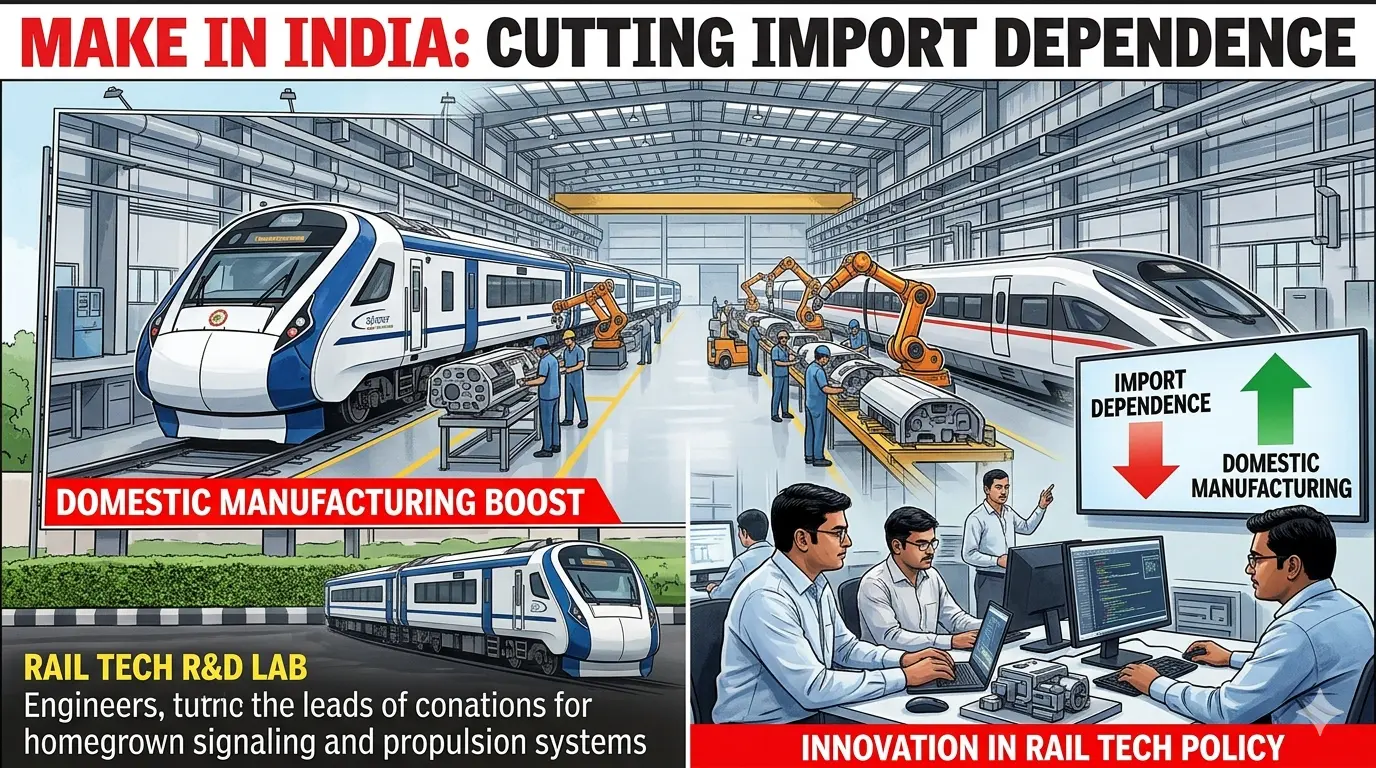
India is preparing to roll out a new 'Rail Tech' policy in the coming weeks, a move aimed at strengthening domestic manufacturing of next-generation railway technology and equipment. The policy framework, being developed by the Railway Board, is expected to offer manufacturers a combination of partial funding, technical support, and access to dedicated testing facilities — giving domestic players the resources they need to compete with international suppliers.
The initiative is a core component of India's broader rail modernisation agenda, and one of its key objectives is reducing the country's dependence on imported railway technology, particularly from China, which currently dominates India's railway equipment import basket.
"A new Rail Tech policy will give much needed impetus to innovation for mass transport," a senior government official told the Economic Times, adding that the framework would actively encourage collaboration between domestic manufacturing firms and research institutions.
The scale of India's current import reliance puts the urgency of this policy into sharp focus. India's imports of railway and tramway locomotives, rolling stock, and associated equipment stood at approximately Rs 6,098 crore in FY25. Locomotive components made up the largest share of that import bill, highlighting the extent to which India depends on foreign-sourced sub-systems to keep its railway network running.
According to trade data and project reports for 2024–25, around 55% of railway component imports are destined for Indian Railways, while the remaining 45% serve metro and rapid rail systems. While imports still represent a relatively limited share of India's total railway component requirements, the government is clearly intent on shrinking that share further through domestic capability building.
The financial commitment backing this shift is significant.
Conference
Conference
The FY27 Union Budget has allocated Rs 52,108.73 crore for rolling stock capital expenditure, an increase from Rs 50,007.77 crore in the current fiscal year. The funds are earmarked primarily for new locomotives, coaches including Vande Bharat train sets, and wagons — all part of a large-scale fleet modernisation programme that is expected to drive sustained demand for domestically produced railway equipment.
The proposed Rail Tech policy builds directly on the foundation laid by the Indian Railway Innovation Policy, which was launched in June 2022. That earlier policy introduced grant support of up to Rs 1.5 crore on a 50:50 cost-sharing basis, targeting startups and smaller companies working to develop functional prototypes in the railway sector. It focused on improving safety, operational efficiency, and maintenance capabilities, while giving innovators ownership over their solutions, access to a secure testing environment, and assured procurement pathways for successful low-cost technologies.
The new framework is expected to go further, scaling up both the ambition and the support mechanisms available to manufacturers at every stage of the development process.
Looking at the bigger picture, India has set an ambitious goal of achieving complete self-sufficiency in building seven new bullet train networks — an aspiration the railway minister has publicly stated. To reach that goal, India will need to rapidly develop domestic expertise across a supply chain that currently leans heavily on imports from multiple countries. Beyond China, Germany and Austria are significant suppliers of engineering systems, while the United States and Japan provide specialised propulsion and signalling components.
The Rail Tech policy is therefore not just an industrial strategy — it is a statement of intent about where India wants to position itself in the global railway technology landscape. By investing in domestic innovation, reducing import dependency, and building collaborative ecosystems between industry and research institutions, India is laying the groundwork to become a self-reliant and potentially competitive force in railway manufacturing for decades to come.
Explore the latest edition of Journal of Supply Chain Magazine and be part of the JOSC News Bulletin.
Discover all our upcoming events and secure your tickets today.
Journal of Supply Chain is a Hansi Bakis Media brand.
Subscribe to our Daily Newsletter
Subscribe For FreeBy continuing you agree to our Privacy Policy & Terms & Conditions