News
India Eases FDI Rules for Border Nations: What It Means for Solar Manufacturing
 Anamika Mishra,
Sub Editor
Anamika Mishra,
Sub Editor
Anamika Mishra,
Sub Editor
Anamika Mishra,
Sub Editor
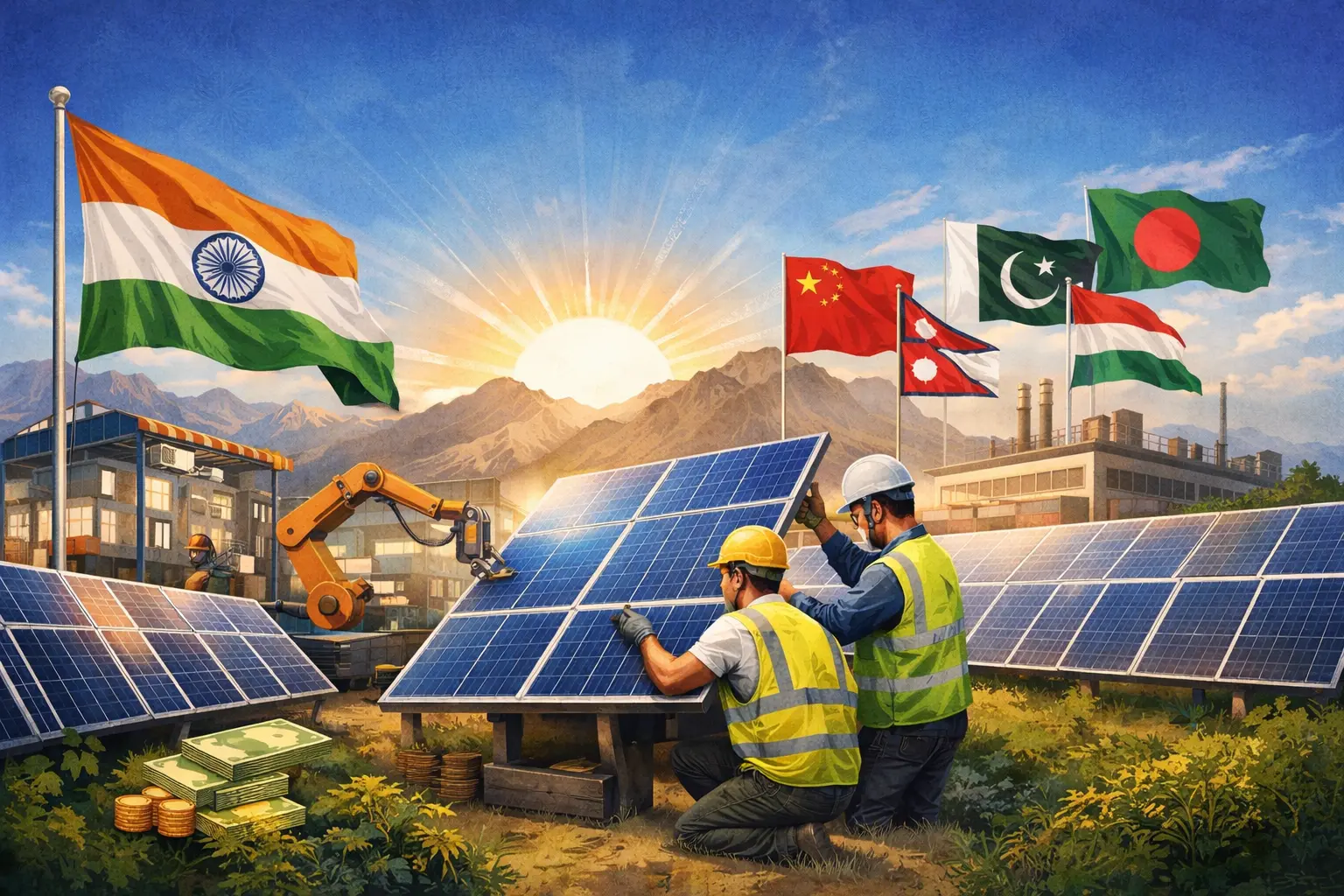
India's Union Cabinet has given the green light to a significant amendment of Press Note 3 of 2020, a regulation that mandates government approval for investments coming from countries that share land borders with India. The revision establishes a 10% beneficial ownership threshold, allowing investors from these neighboring countries to invest through the automatic route without needing prior government clearance if they stay below this limit. For India's power sector, the primary impact of this change centers on the upstream solar manufacturing supply chain.
What's new under the amended investment framework
Press Note 3 of 2020 came into effect during the COVID-19 pandemic as a protective measure against opportunistic takeovers of struggling Indian companies by investors from neighboring nations. China was widely understood to be the main target of this regulation. The original rule was strict: even the smallest beneficial ownership stake from a country sharing a land border with India would trigger the requirement for government approval.
The updated framework, released by the Department for Promotion of Industry and Internal Trade (DPIIT), now draws on beneficial ownership definitions from the Prevention of Money Laundering Rules. Under the new system, investors from land-bordering countries can hold non-controlling stakes of up to 10% and invest through the automatic route, provided they comply with sectoral investment caps and submit mandatory disclosures to DPIIT. Any investment exceeding that 10% threshold still requires government approval.
Another notable feature of the amendment is the introduction of a 60-day processing window for approval-route proposals in certain manufacturing sectors. These sectors include capital goods, electronic capital goods, electronic components, and critically, polysilicon and ingot-wafer manufacturing. In every one of these cases, the majority ownership and operational control of the Indian entity must stay with resident Indian citizens or entities that are owned and controlled by them.
Upstream solar manufacturing continues to face constraints
The decision to include polysilicon and ingot-wafer manufacturing in the expedited approval category has direct relevance for the power sector. These production stages represent the upstream portion of the solar photovoltaic supply chain, an area where India's domestic capacity lags significantly behind its downstream manufacturing capabilities.
Data from the Ministry of New and Renewable Energy (MNRE) shows that India's solar module manufacturing capacity jumped from 38 GW in March 2024 to 74 GW in March 2025. Over the same timeframe, the country launched its first 2 GW of ingot and wafer manufacturing capacity, and solar cell manufacturing capacity nearly tripled.
Despite these advances, upstream capacity remains underdeveloped. The Production Linked Incentive (PLI) Scheme for High-Efficiency Solar PV Modules has been instrumental in driving downstream manufacturing expansion, but polysilicon and wafer production have not kept pace. According to an assessment by the Institute for Energy Economics and Financial Analysis (IEEFA), India currently has 3.3 GW of operational polysilicon production capacity and 5.3 GW of annual nameplate wafer capacity.
India's reliance on imports remains substantial. In 2024, the country imported 65.9 GW worth of solar cells and modules, with cells making up 64% of those imports. That same year, India added 11.6 GW of solar cell manufacturing capacity.
China's dominance of the global supply chain
The limited domestic upstream capacity in India is a reflection of global supply chain realities. According to the International Energy Agency (IEA) Special Report on Solar PV Global Supply Chains, China controls more than 80% of global manufacturing capacity across the key stages of solar panel production.
When it comes to polysilicon and wafer manufacturing specifically, China's share is expected to surpass 95% based on capacity that is currently under construction. The IEA also highlights that China's Xinjiang province alone is responsible for roughly 40% of global polysilicon production, and that one in every seven solar panels manufactured worldwide comes from a single production facility.
Given this backdrop, the rapid scaling of upstream solar manufacturing in India is challenging without access to Chinese technology or capital. The revised foreign direct investment (FDI) framework could open the door to joint ventures or technology partnerships in which Chinese firms take minority stakes below the 10% threshold, or pursue larger investments that would be processed within the 60-day approval timeline.
Conference
Conference
Current foreign investment trends in India's energy sector
India's FDI policy permits up to 100% investment under the automatic route in the renewable energy sector. From April 2020 to June 2025, the sector attracted $23 billion in foreign investment under this framework.
Looking at the broader power sector, which includes conventional generation and distribution, cumulative FDI inflows have reached $19.68 billion. The sector posted impressive 144% year-on-year growth in FY 2023-24, with inflows totaling $1.7 billion.
Chinese investment, however, represents only a small fraction of overall FDI. According to DPIIT data, China ranks 23rd among investing countries, accounting for just 0.32% of total inflows. This translates to approximately $2.51 billion across all sectors from April 2000 to December 2025.
What the revised rules could mean in practice
The introduction of the 10% automatic-route threshold is not expected to lead to significant Chinese ownership of Indian power generation or grid assets in the near term. Its most immediate impact is likely to be felt in global private equity and venture capital investments where a Chinese limited partner holds a small, non-controlling stake. Under the previous framework, such investments required government approval regardless of the level of influence or control involved.
For the power sector specifically, the provision allowing faster approval for polysilicon and ingot-wafer manufacturing projects could prove more consequential. The measure is designed to enable Indian manufacturers to form joint ventures with international upstream producers while maintaining majority ownership and control.
India's National Electricity Plan 2022-32 projects that the power sector will need approximately $400 billion in investment through 2032. Expanding upstream solar manufacturing capacity is viewed as essential to achieving the country's target of 500 GW of non-fossil fuel capacity by 2030. According to MNRE data, India had installed 242.8 GW of non-fossil fuel capacity as of June 2025, including 233.99 GW from renewable energy sources.
Debate surrounding supply chain dependencies
The amendment does not change the policy framework governing foreign investment in transmission and distribution infrastructure. Grid infrastructure has not been designated as a sector open to Chinese ownership. The requirement that majority ownership and control remain with Indian entities continues to apply to investments covered under the revised rules.
Nevertheless, some policy discussions have raised concerns about technological dependence that could arise from minority joint ventures in manufacturing sectors that supply grid-connected equipment. Even without formal ownership control, such arrangements could introduce supply chain vulnerabilities.
The IEA has similarly observed that geographical concentration in solar manufacturing supply chains creates structural risks regardless of who owns the final installations. The longer-term impact of this policy revision will hinge on how investment patterns develop and how effectively the disclosure and ownership requirements are enforced and monitored over time.
Explore the latest edition of Journal of Supply Chain Magazine and be part of the JOSC News Bulletin.
Discover all our upcoming events and secure your tickets today.
Journal of Supply Chain is a Hansi Bakis Media brand.
Subscribe to our Daily Newsletter
Subscribe For FreeBy continuing you agree to our Privacy Policy & Terms & Conditions