News
How Automation Is Reshaping India's Frozen Food Manufacturing at Scale
 Our Correspondent,
Our Correspondent,
Our Correspondent,
India's frozen food manufacturing sector has transformed considerably over the past decade. What began as a largely manual, volume-driven operation has evolved into a sophisticated, technology-led industry focused on consistency, efficiency, and scalability. At the heart of this shift are two converging forces: industrial automation and advanced process engineering.
The case for transformation is rooted in the nature of frozen food itself. Unlike many product categories, frozen foods carry an implicit consumer promise that every unit, from the first batch to the millionth, will deliver the same taste, texture, and quality. Fulfilling that promise at scale is where manual processes fall short. India's agricultural landscape compounds the challenge. Regional variation, seasonal flux, and inconsistent raw material quality make standardization through human labor alone practically unworkable at high volumes.
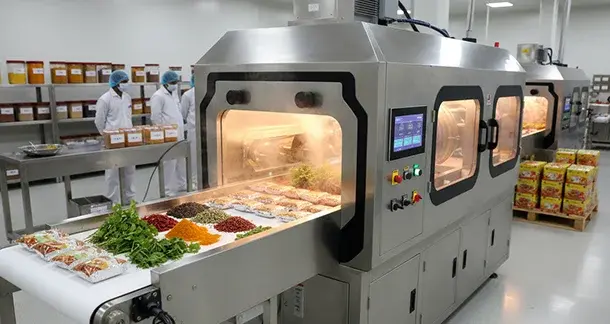
Automation addresses this directly. Across the production floor, leading manufacturers have deployed automated systems for sorting, grading, cutting, frying, freezing, and packaging. The operational gains are measurable: industry estimates suggest automation drives processing efficiency up by 20 to 30 percent and cuts material waste by as much as 15 percent. For a sector where margins are tightly tied to yield and throughput, these figures are not incremental they are foundational.
Beyond efficiency, automation brings a discipline to quality control that manual inspection simply cannot replicate at volume. Every production batch is assessed against defined standards automatically, removing the variability that human oversight introduces over long shifts and large runs. As the Indian frozen food market moves toward a projected value of $3.5 to $4 billion by 2026, and as the broader food processing industry eyes $500 billion in growth by 2030, the ability to consistently meet quality benchmarks at scale becomes a core competitive requirement rather than a differentiator.
Process engineering is what makes automation coherent. Automation executes tasks with precision; process engineering designs the operational framework that determines which tasks get automated, in what sequence, and to what standard. Done well, it removes bottlenecks, reduces idle time between stages, and creates a production system that improves continuously rather than degrading over time.
Conference
Conference
In frozen food manufacturing, where raw materials become unusable if they drift outside defined time-temperature windows, this kind of engineered control is not optional it is existential.
Temperature management is one area where the integration of automation and process engineering is particularly consequential. The cold chain in India is expanding rapidly, with the market expected to grow at 14 to 15 percent annually as infrastructure investment accelerates. Automated sensors paired with engineered workflows now allow manufacturers to monitor temperature in real time across processing, storage, and distribution stages. The result is both a quality safeguard and a compliance mechanism, particularly important as Indian exporters face increasingly stringent international food safety requirements.
End-to-end traceability has emerged as another significant development. Data-driven tracking systems now follow product movement from farm sourcing through to finished goods, creating a transparent record across the value chain. This supports food safety protocols and satisfies the compliance expectations of global markets a prerequisite for India's ambitions as a processed food exporter.
The workforce dimension of this transition is also worth noting. Automation does not eliminate the need for skilled people; it redirects them. When routine, repetitive tasks are handled by machines, workers are freed to focus on higher-value activities quality assurance, process refinement, innovation, and problem-solving. This reallocation is not just operationally sensible; it is necessary for sustaining long-term improvement.
Looking ahead, the technological trajectory points toward even deeper integration. Predictive maintenance driven by data analytics is already reducing equipment downtime by around 30 percent in advanced facilities. Artificial intelligence is being applied to real-time defect detection and quality assessment. Supply chain integration is making manufacturing systems more responsive to upstream and downstream variability. Each of these developments reinforces the others, building a production environment that is both more resilient and more capable.
India stands at an inflection point. The investments being made today in automation and process engineering are not simply operational upgrades they are strategic commitments that will determine whether Indian frozen food manufacturers can compete credibly in global markets. Quality and safety standards in those markets are high and rising. Meeting them consistently, at volume, and at competitive cost is the challenge. The manufacturers building these systems now are positioning themselves to meet it.
Explore the latest edition of Journal of Supply Chain Magazine and be part of the JOSC News Bulletin.
Discover all our upcoming events and secure your tickets today.
Journal of Supply Chain is a Hansi Bakis Media brand.
Subscribe to our Daily Newsletter
Subscribe For FreeBy continuing you agree to our Privacy Policy & Terms & Conditions