News

Qatar and UAE set to join U.S.-led push to strengthen global technology supply chains

January 12, 2026 3 min read
author Anamika Mishra, Sub Editor

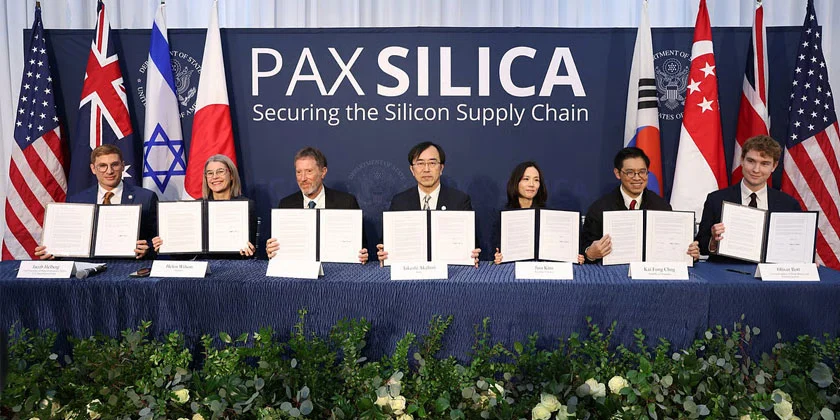
Qatar and the United Arab Emirates are set to join a U.S.-led initiative aimed at securing artificial intelligence and semiconductor supply chains, Undersecretary of State for Economic Affairs Jacob Helberg said in an interview with Reuters.

The inclusion of the two Gulf nations is significant given the Middle East’s long-standing political divisions, and reflects Washington’s broader effort to bring Israel and key Gulf states into a shared, technology-driven economic framework.

The initiative, known as Pax Silica, is designed to protect the entire technology supply chain, spanning critical minerals, advanced manufacturing, computing capacity and data infrastructure. It forms a central pillar of the Trump administration’s economic statecraft strategy, which seeks to reduce reliance on rival nations while deepening cooperation among trusted partners.

“The Silicon Declaration is not merely a diplomatic statement,” Helberg said. “It is intended to function as an operational blueprint for a new consensus on economic security.”

The group currently includes Israel, Japan, South Korea, Singapore, Britain and Australia. Qatar is expected to sign the Pax Silica declaration on January 12, with the UAE following on January 15.

Unlike traditional alliances, Pax Silica is structured as what Helberg described as a “coalition of capabilities,” where participation is determined by each country’s industrial strengths and the global reach of its companies.

Helberg said he believes the initiative could help accelerate the Middle East’s transition away from energy dependence toward more diversified, technology-led growth.

“For both the UAE and Qatar, this represents a move from a hydrocarbon-focused security model to one centred on silicon-based statecraft,” he said.


The announcements come ahead of the Future Minerals Forum, a government-backed global conference on minerals and supply chains hosted by Saudi Arabia, which will bring senior officials, industry executives and investors to Riyadh from January 13 to 15.

Helberg said the Pax Silica group will focus this year on expanding its membership, developing strategic projects to secure supply chains, and aligning policies to safeguard critical infrastructure and sensitive technologies.

The group last met in Washington in December, and Helberg said he expects it to convene several times over the course of the year.

He added that discussions are ongoing around projects that could modernise trade and logistics corridors, including the India–Middle East–Europe Corridor, by deploying advanced U.S. technologies to deepen regional integration and extend America’s economic presence.

U.S. and Israeli officials are also preparing to launch a Pax Silica–linked Strategic Framework, which includes plans for the “Fort Foundry One” industrial park in Israel to fast-track industrial projects. Cooperation on artificial intelligence will also be on the agenda, with a memorandum of understanding tentatively scheduled for January 16.

As AI computing power reshapes global markets, investors are increasingly looking to technology-driven strategies to identify the next wave of outperforming stocks. Advanced AI-based investment models are now tracking portfolios that have consistently beaten benchmark indexes, with several technology-focused strategies delivering strong returns in recent years.

The question for markets, analysts say, is which company will be the next major beneficiary of this rapid technological shift.


Explore the latest edition of Journal of Supply Chain Magazine and be part of the JOSC News Bulletin.

Discover all our upcoming events and secure your tickets today.


Journal of Supply Chain is a Hansi Bakis Media brand.

Leave Comment

logo

Subscribe to Our Newsletter

The week’s best stories, handpicked by JOSC editors in your inbox every week.

Stay informed with exclusive content