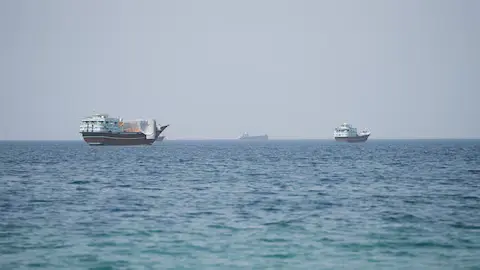
WASHINGTON: The US Central Command (CENTCOM) on Wednesday rejected Iran's claim that the Strait of Hormuz has been closed, saying commercial and energy shipments are still moving through the strategically important waterway.
CLAIM: Earlier today, a general from Iran's Islamic Revolutionary Guard Corps claimed in media reports that 'the Strait of Hormuz is closed' and his country has 'full control over it.' This is FALSE," CENTCOM said in a post on X.
FACT: Traffic is flowing through the Strait of Hormuz right now carrying commercial goods and energy supplies, including 20 million barrels of crude oil. The United States and regional partners clearly control the strait," it added.
The statement followed remarks by Mohammadreza Naqdi, an adviser to the commander of Iran's Islamic Revolutionary Guard Corps (IRGC), who repeated Tehran's position on the strategic waterway in comments to the semi-official Fars news agency on Wednesday, Al Jazeera reported.
Naqdi also warned that transit routes considered illegal by Iran would be closed soon.
Meanwhile, Iranian Foreign Ministry spokesperson Esmaeil Baghaei said Tehran had "clearly and firmly" outlined its conditions for ending the war on all fronts and restoring security across the Gulf and the Strait of Hormuz.
According to Iran's state broadcaster IRIB, Baghaei said Tehran would also convey its response to US proposals through mediators, Al Jazeera reported.
Baghaei further said Iran and Oman had reached an understanding regarding the safe passage of vessels through the Strait of Hormuz and would soon submit the agreement to the relevant international body.
"The consultation process between Iran and Oman has been carried out well, and the two sides, in addition to agreeing on the geographical coordinates of safe routes to and from the Strait of Hormuz, have also reached an understanding on how to reflect the issue at the relevant international authority level, which, God willing, will be done soon," Baghaei was quoted by the official IRNA news agency as saying, as reported by Al Jazeera.
The latest developments come as tensions around the Strait of Hormuz remain high amid the ongoing conflict between the US and Iran.
Earlier on Wednesday, US President Donald Trump said the war with Iran would end "very quickly" and predicted that oil prices would "come tumbling down". He also claimed that the US had taken away Iran's nuclear power.
"It is a war from the standpoint of what we have to do. We have to get rid of the nuclear weapons for Iran. We have taken away their nuclear power. If they had nuclear power, you would have had problems like you have never had before," Trump told reporters while leaving Washington for a Republican campaign rally in San Antonio.
"Their whole country right now is wiped out. It will be over very quickly, and when it does, oil prices will come tumbling down," he added.
Meanwhile, Iranian government spokesperson Fatemeh Mohajerani rejected Trump's claim that Iran's oil minister had resigned because of pressure linked to the US war, calling the statement "a futile effort to hide his own failures", Al Jazeera reported.
Mohajerani said the resignation of the oil minister was "not a sign of weakness", but instead reflected flexibility within a stable political system.
Iranian Foreign Minister Abbas Araghchi has meanwhile said that although Iran remains determined to defend itself, its officials are serious about pursuing diplomacy to protect the country's interests and national security.
Conference
Conference
Araghchi said Iran's delegation to the United Nations General Assembly in New York used the visit to present a seven-day peace proposal to the US aimed at reopening the Strait of Hormuz, Al Jazeera reported, citing his Telegram channel.
Trump rejected the Iranian proposal a day after it was presented late last month, while US officials put forward a counterproposal aimed at restarting negotiations to bring the war to an end.
Trump on Tuesday also repeated his claims that the US controlled maritime traffic through the Strait of Hormuz, saying the waterway "belongs to the United States Navy and the United States". He described the US naval presence there as an effective blockade against Iran.
Speaking at Sparrows Point in Maryland, Trump said the US Navy was enforcing what he described as "one of the most effective and impenetrable blockades in history".
"Nobody's ever seen a blockade like that, with no ships-zero-getting in," Trump said, adding that oil shipments from outside Iran had recovered to levels "almost higher than they've ever been."
Trump also explained how vessels attempting to travel through the waterway were being handled.
"Every once in a while, they'll do a run, and they'll either hit the cabin-if it's got oil, they'll hit the cabin, or they'll hit the rudder. If it doesn't have oil, we just sink the ship," he said.
"In other words, the Hormuz Strait belongs to the United States Navy and the United States of America. That's where it belongs, and that's where it is right now," Trump said.
During the same event, Trump said the US would continue to be the world's leading naval power and claimed that Iran's military capability had been severely weakened.
"We're doing extremely well in the Islamic Republic of Iran, very well. They have no military. It's shot; the whole place is shot. And they were the evil one. They were the bully of the Middle East. They're not so much the bully anymore, but we have to finish up. And it's only a question of which way do we want to do it, the nice way or the not-so-nice way? And pretty soon you'll find out," Trump said.
Referring to US actions in the Strait of Hormuz, Trump said he preferred to describe the maritime measures as a "wall of steel" rather than a blockade.
Trump has also said that the US Navy was working to ensure Iran would not obtain a nuclear weapon.
He has repeatedly claimed that the US controls the Strait of Hormuz amid the ongoing conflict with Iran, saying the US Navy has restricted maritime traffic involving Iranian vessels and ports in the strategic waterway.
Explore the latest edition of Journal of Supply Chain Magazine and be part of the JOSC News Bulletin.
Discover all our upcoming events and secure your tickets today.
Journal of Supply Chain is a Hansi Bakis Media brand.
Subscribe to our Daily Newsletter
Subscribe For FreeBy continuing you agree to our Privacy Policy & Terms & Conditions