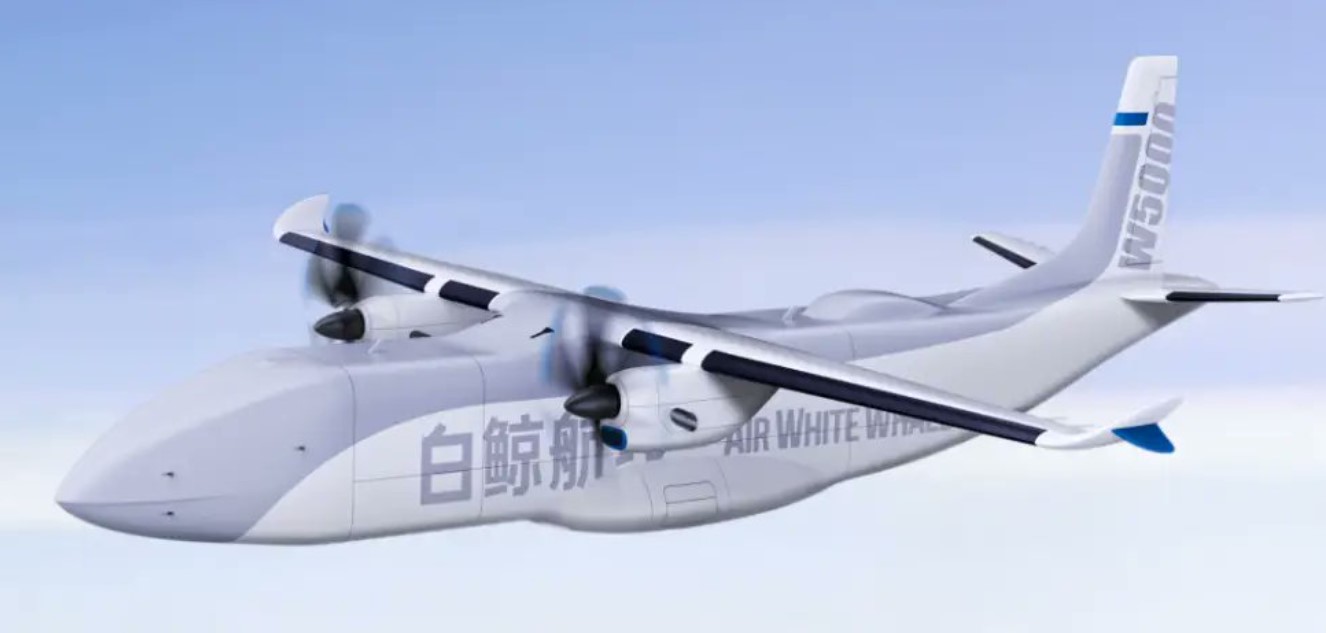
China's Air White Whale has successfully completed the maiden flight of its W5000 cargo drone, which the manufacturer describes as the world's largest unmanned cargo aircraft by maximum payload capacity. Designed to carry up to 5 tonnes of cargo over a distance of 2,600 km, the aircraft completed its first 30-minute flight on November 14 at Otog Qianqi Airport in the Inner Mongolia Autonomous Region.
The Changzhou municipal government shared details of the development through China's state news agency Xinhua.
During the test flight, the W5000 accelerated along a runway of approximately 600 metres before taking off and climbing to an altitude of 1,000 metres above the airfield. It successfully performed several flight manoeuvres, including climbing, level flight, four turns and descent, before returning safely to the runway.
The aircraft recorded an indicated airspeed of around 220 kmph during its climb, while its vertical speed reached 5 metres per second.
The first flight was primarily intended to check the aircraft's flight stability and assess the performance of its propulsion, avionics, automatic flight control and ground control systems. According to reports, the aircraft successfully completed all the planned stages of the flight test.
Conference
Conference
Summit
Developed by Air White Whale for regional freight transportation, the W5000 is being positioned by the manufacturer as the world's largest unmanned cargo aircraft based on maximum payload capacity.
The aircraft has a maximum take-off weight of 10.8 tonnes and can transport cargo weighing up to 5 tonnes. Its stated operating range is 2,600 km, while the cargo compartment offers more than 65 cubic metres of space, making it suitable for standard air cargo containers and pallets.
The W5000 measures 22.89 metres in length and has a wingspan of 22.7 metres. It is equipped with two Chinese-made turboprop engines and makes extensive use of carbon-fibre composite materials in its fuselage to keep structural weight under control.
Its autonomous flight control system allows the aircraft to operate under the supervision of operators at a ground control station. The design also supports operations from civilian airports and general aviation airfields, offering the possibility of using existing aviation infrastructure.
According to Air White Whale founder and CEO Hu Zhendong, removing the pilot and related onboard equipment could bring down the cost of transporting one tonne of cargo per kilometre by more than 60% compared with conventional piloted cargo aircraft in the same category.
The W5000 programme has been under development for several years. Its first full-scale prototype, named Longcheng-1, was assembled at Air White Whale's Changzhou facility in October 2024. Before taking to the skies, the aircraft underwent multiple ground tests to check its structural strength, control systems and onboard equipment.
The company currently says it has received 835 preliminary orders for the W5000. It is aiming to begin commercial operations in late 2027, subject to successful completion of the remaining tests and certification requirements.
The project highlights China's growing focus on autonomous aircraft for freight transportation, particularly in regional markets where better cargo connectivity is needed and conventional air freight infrastructure may be limited.
Another Chinese unmanned cargo aircraft programme attracting attention is the FP-985 Taurus, which has been developed from the An-2 aircraft. With a payload capacity of 2 tonnes, the aircraft has already completed a flight covering more than 1,100 km.
The W5000's successful maiden flight represents a significant step forward in the development of large-capacity unmanned cargo aircraft. If the company achieves its planned commercial launch, the aircraft could offer freight operators another option for regional air cargo transportation. Its carrying capacity, operating range and potential cost advantages will be important factors in determining its commercial acceptance.
Explore the latest edition of Journal of Supply Chain Magazine and be part of the JOSC News Bulletin.
Discover all our upcoming events and secure your tickets today.
Journal of Supply Chain is a Hansi Bakis Media brand.
Subscribe to our Daily Newsletter
Subscribe For FreeBy continuing you agree to our Privacy Policy & Terms & Conditions